About Hybrid Methods
The Theta, Log Theta, and Vanguard Dampened Trend methods use combinations of regression, data smoothing, and other data analysis techniques. Each method deals with seasonality in the following way:
- The historical data is de-seasoned.
- The forecasted data is created.
- The forecasted data is re-seasoned to produce the final forecast.
See About Forecasting Methods.
Theta
The Theta method is a special version of simple exponential smoothing with added trend and seasonality components. The following equations do not include the seasonal adjustments.
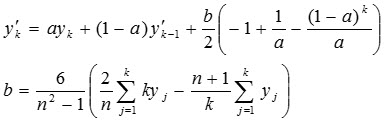
Parameters can be automatically determined or you can enter them manually:
- a: Level smoothing factor
The level-smoothing constant must be between zero and one inclusive. At most, you can include two different cyclic patterns. These are referred to as the season and the cycle. The season and cycle have different durations, and the cycle encompasses multiple seasons. - p1.p2: Period
The period is comprised of two parameters: the season period (p1) and the cycle period (p2). The season period defines the number of periods occurring between two successive starts of the season. The cycle period is a multiplier of the season period.
For example, a quarterly season with monthly data points has a season period of three. If there is also an annual cycle, then there are 4 seasons per cycle; therefore, the cycle period is four. The cycle period is optional and only the season is forecasted if it is omitted. The season period must be greater than zero.
Log Theta
The Log Theta method is similar to the Theta method except the historical data and the forecasted values respectively undergo log and exponential data transformations. The Theta method assumes randomness (or noise) in the historical data is normally (Gaussian) distributed. However, most business data tends to have log-normally distributed randomness. The data transformations of the Log Theta method adjust your data accordingly.
Parameters can be automatically determined or you can enter them manually:
- a: Level smoothing factor
The level-smoothing constant must be between zero and one inclusive. At most, you can include two different cyclic patterns. These are referred to as the season and the cycle. The season and cycle have different durations, and the cycle encompasses multiple seasons. - p1.p2: Period
The period is comprised of two parameters: the season period (p1) and the cycle period (p2). The season period defines the number of periods occurring between two successive starts of the season. The cycle period is a multiplier of the season period.
The process is as follows:
- The historical data undergoes a log transformation, meaning the natural log of each data point is taken.
- The Theta method is applied to the transformed data.
- The forecasted values calculated by the Theta method undergo an exponential transformation, that is, the exponential of each data point is taken to produce the final forecast.
Since the Log Theta method uses a log transform, all historical data points must be positive.
Vanguard Dampened Trend
This proprietary method combines regression, data smoothing, seasonality, decay/growth, and other data analysis techniques. Based on its parameter values, the Vanguard Dampened Trend method may actually reduce to many other forecasting methods such as Simple exponential smoothing, Holt’s Linear method, the Winter’s methods, and others. However, due to its robust parameter optimization process, the Vanguard Dampened Trend method tends to find better parameter values and therefore produce better forecasts than these methods would by themselves.
Most forecasting methods rely on the assumption that randomness (or noise) in the historical data is normally (Gaussian) distributed. The Vanguard Dampened Trend method assumes this randomness is log-normally distributed, which tends to model business data better. This increases the accuracy of the forecast.
Parameters can be automatically determined or you can enter them manually:
- a: Level smoothing factor
- b: Trend smoothing factor
The level and trend smoothing factors must be between zero and one inclusive. - c: Trend scale factor
The trend scale factor must be greater than or equal to zero. - p1.p2: Period
The season period must be greater than zero. See the Theta method for an explanation of the period.