Stochastic Record
Using Stochastic records, you can apply a distribution type and have CCH Tagetik Supply Chain Planning run Monte Carlo simulations to supply the data. A common use of Stochastic records is for risk analysis.
Stochastic Record
Stochastic records can contain some or all of the following sections:
- Bill of Materials section
See BOM Part Record in Classic Mode. - Stochastic section
Stochastic section
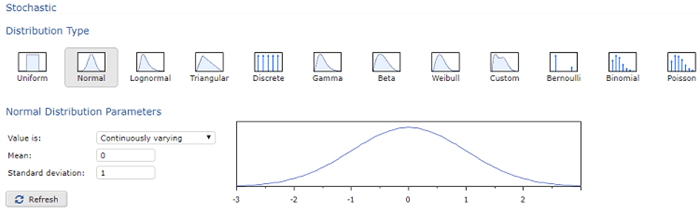
Following are the distribution types available in Stochastic records.
Stochastic Record Types
| Distribution Type | Description |
|---|---|
| Uniform | Numbers returned are drawn from a uniform distribution between the two limits you specify. These numbers are greater than or equal to the lower limit, less than the upper limit, and equally likely to be any value in-between. |
| Normal | Numbers returned are drawn from a normal (Gaussian) distribution. This distribution is characterized by the mean and standard deviation of the desired distribution. |
| Lognormal | Numbers returned are drawn from a lognormal distribution. This distribution is characterized by the mean and standard deviation of the desired distribution. Lognormal distributions are often used to model price movements in financial instruments, such as stocks. The numbers returned are always greater than zero. |
| Triangular | Numbers returned are drawn from a triangular distribution using the limits and most-likely value you specify. This distribution is useful when you are modeling subjective estimates that lack a more specific theoretical foundation. The normal distribution is also useful for this purpose. |
| Discrete | Numbers returned are always integers between the specified limits, and are equally likely to be any of these integers. |
| Gamma | Numbers returned represent the time required for a certain number of events to occur given the mean time between events (for example, the time required for a certain number of customers to arrive). The numbers returned are always greater than zero. |
| Beta | Beta distributions are often used to create a distribution matching experimental data. The two positive input parameters, alpha and beta, control the shape of the distribution. |
| Weibull | Numbers returned often represent the lifetimes of parts, or durations of events (for example, the time until a critical part in a product fails, or the delivery lead-time of a product order). The numbers returned are always greater than zero. |
| Custom | If you cannot find the random number generator with the distribution you want, you can create a custom generator. To do this, you need an equation for the desired probability density function (PDF). To specify an equation for the custom distribution, input the formula as a function of the variable x, along with upper and lower limits in which to sample the function. You must also know, or approximate, a maximum value your function has within those limits. For example, suppose you want to create a random number generator with a normal (or Gaussian) distribution. The easiest way to do this is to use the built-in Normal distribution. However, if you used the custom generator tool, the equation for a Gaussian distribution with a mean of zero and a standard deviation of one is as follows: 1/sqrt(2PI)*exp(x^2/-2) One peculiar property of this equation is that x extends from negative infinity to positive infinity. However, you need explicit limits. If you graph the function, the curve approaches zero at about -4 and 4, so you can use these values for the limits. Another feature of this equation is that it is difficult to know the exact maximum value. To find this automatically, you can click Find Max. You do not need to be exact about the limits in order for the custom generator to work properly. However, if you select limits that are too tight, the distribution is distorted. If you select limits that are too relaxed, the generator is slow. |
| Bernoulli | A Bernoulli random number is always zero or one with the specified probability being one. Bernoulli random numbers are useful when you are trying to model cases where an event occurs or does not occur. The Bernoulli distribution is a special application of the Binomial distribution, where the number of trials is set to one. |
| Binomial | Numbers returned represent the number of successes in an experiment, given the probability of an individual success and the number of trials (for example, the number of times heads comes up when you flip a coin 10 times). |
| Poisson | Numbers returned represent the number of random events that occur per unit of time (for example, the number of customers that arrive in a given hour). This probability distribution is characterized by the mean number of events per unit time. The numbers returned are always positive integers. |
To configure a Stochastic record
- In the Stochastic section, select a Distribution Type and set the parameters.
- In the upper-right of the screen, click OK.
- To save your changes to the database, on the menu, click Save All Changes.