Consolidated financial statements
Introduction
Consolidated financial statements gather the data of the entities in a group to be able to show them and analyse the returns as if the entities were a single entity.
CCH Tagetik allows you to run the following actions:
- Manage complex statutory and management consolidation processes and intercompany entry reconciliation processes.
- Track the consolidation operations in a structured and standardised environment with the planning and budget activities.
- Ensure consistency between statutory and management reporting.
- Unify the closing process of individual entities (legal entity) with the group consolidation process.
- Manage several sets of accounting standards (IFRS, local GAAP, etc.), thus improving the visibility and transparency of data and guaranteeing compliance with regulations.
- Reduce closing cycle and reporting production times.
Overview of the consolidation process
The consolidation process typically follows the following steps:
- Consolidation area definition: all the entities to be included in the process are identified and their consolidation method is specified.
- Standardisation of the entities’ financial statements: the group accounting standards are applied to then obtain aggregated financial statements.
- Preparation of the consolidation with adjustment journals: the intercompany eliminations are identified, the minorities are calculated and the equity evaluation is run.
- Preparation and publication of the consolidated financial statements: the consolidation process is completed.
The data resulting from every step are registered with a different “amount type” which tells you the step in which they were generated. This allows you to examine the intermediate results at any time and provides full traceability of the various calculations performed by CCH Tagetik.
The consolidation process is described in the following diagram:
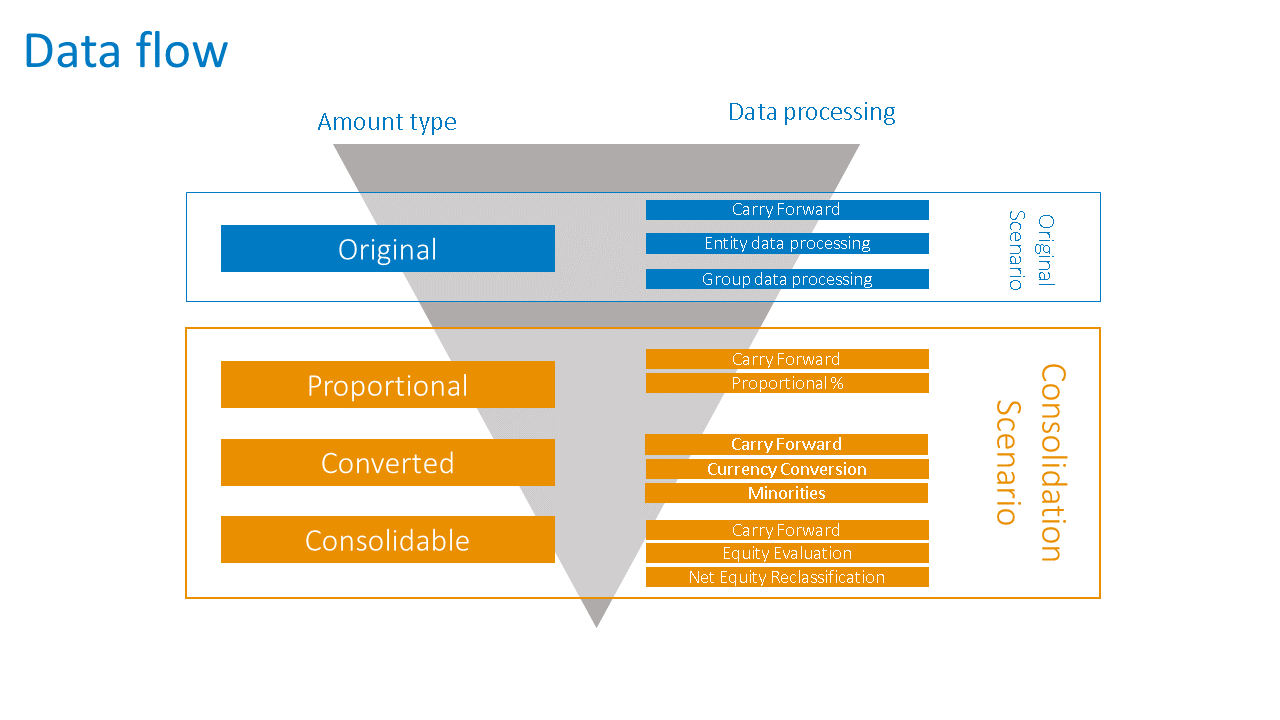
In CCH Tagetik, the data for individual entities are inserted on the original scenarios without considering how the entity will contribute to any consolidated financial statements. Neither the consolidation currencies nor the consolidation methods and percentages are specified. This information is only indicated in consolidation scenarios. For this reason, the following situations can be created:
- The original scenario contains journals in a currency different from the consolidation scenario currency. This requires a currency conversion for consolidation.
- The original scenario contains entity journals that do not fall within the consolidation perimeter, or fall within it but are consolidated at net equity. These journals must therefore be ignored by the consolidation process.
Contributor activities for consolidation
In the context of the consolidation process, the contributor must run the following actions:
- Insert the gross and intercompany amounts on the contributor categories.
- Insert the entity journals on the contributor categories. These journals are submitted together with the financial statement data.
- Match intercompany entries.
- Run diagnostics and the submission of the entered data.
- Run the data processing by entity.
Consolidator activities for consolidation
In the context of the consolidation process, the consolidator must run the following actions:
- Insert the entity journals on the consolidator categories. These journals are submitted together with the consolidation journals.
- Enter the consolidation journals manually and, if necessary, integrate automatic eliminations.
- Run diagnostics and the submission of the entered data.
- Run group and area consolidation data processing.
Outcome of the data processing
The data processing writes data both on the original scenario and on the consolidation scenario. However, only the system can write on the consolidation scenario.
| Data Processing | Description |
|---|---|
| Data processing on the original scenario | |
| Data processing by entity | All the amounts and all the entity journals are processed, regardless of the category type. All the data processing activated on the process for the group are run (calculation logics, deconsolidation, balancing, etc.). |
| Group consolidation data processing | All the data processing activated on the process for the group are run (counterparty eliminations, net equity eliminations, deferred taxes, etc.). |
| Data processing on the consolidation scenario | |
| Area consolidation data processing | All the data necessary to generate the final, consolidable amount for the processed area are processed. All the data processing activated on the process for the group are run (contribution data processing, deconsolidation, balancing, etc.). |
The data processing is activated by process depending on the type of action to be managed (Consolidation, Calculation logic, Carry forward, etc.). For more details on data processing linked to consolidation, see .