Hierarchies: basic concepts
Definition
The hierarchy is a multi-level structure that allows you to aggregate and organise several elements. Hierarchies have the following characteristics:
- multi-level structure with unlimited depth, i.e. the elements may be aggregated to different levels.
- single-parent structure, i.e. each child element in the hierarchy may be related to a single parent element.
- unlimited alternative hierarchies, i.e. it is possible to create an unlimited number of different hierarchies for each dimension.
Note: alternative hierarchies for the same dimension may be crossed during the reporting stage.
Example hierarchy
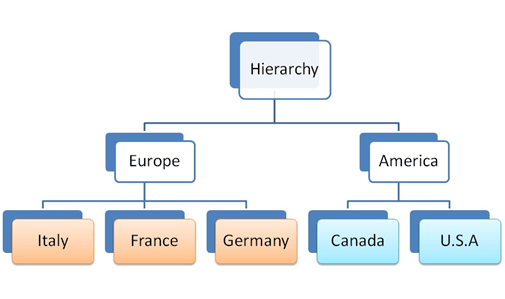
In this example, the elements are grouped together based on geographic area, on three levels. The Italy node is related to the Europe node and cannot be related to the America node at the same time.
Restrictions on the creation of hierarchies
The following restrictions exist on the creation of hierarchies:
- It is only possible to define hierarchies for the Entity, Account, Custom and Analytical dimensions.
- The Account and Entity dimensions always have a default hierarchy ($), to which the new elements are related.
Note: the "$" hierarchy collects all the accounts created, including non-related accounts, i.e. those that have not been inserted in any hierarchy or grouping.
Hierarchy types
The type of hierarchy is marked by a symbol.
| Symbol | Name | Description |
|---|---|---|
| Basic | Generic relationships that can be used for any type of hierarchy. | |
| Geographical | The relationships reflect global regions, nations and departments. | |
| Organisation | The relationships represent the group's organisational structure. | |
| Time-dependent | The relationships between elements and nodes are not fixed, but depend on the scenario and period. |
Example of a time-dependent hierarchy
In this example, the hierarchy groups the companies based on the number of employees:
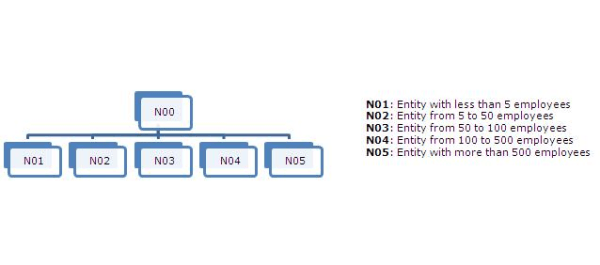
If a company has 40 employees in 2011C/December and 55 employees in 2012C/January, it must be classified in the N02 node for the 2011C Scenario and Period 12, and in the N03 node for the 2012C Scenario and Period 01. The hierarchical structure does not change, but the relationships between the company and the hierarchy nodes alter depending on the scenario and the period.