Category: basic concepts
Definition
The category is the dimension that allows data, especially journals, to be classified and segmented. It also allows you to keep track of the way in which data are generated. In fact, classifying the data into different categories allows you to:
- treat them differently during processing
- view them separately in the forms.
Classification by data source
A given amount may be the result of several operations; each operation can be classified with a category. This allows you to analyse the figures separately in order to understand where to intervene.
Category types
| Category | Description |
|---|---|
| Amount | This identifies the original data, gross amounts and intercompany entries. Generally speaking, only one amount category is necessary, but it is possible to create more in the following cases: - when it is necessary to manage adjustments as amounts and therefore to be able to modify them from the forms - when it is necessary to store data coming from different information systems, for example, the general ledger, analytical accounts, etc. |
| Company journals | This identifies the journals that describe changes to the original data for each company. By default, this has the same currency as the company for which it has been inserted; in a consolidation process, it is used to align the financial statements to the holding company’s accounting standards. |
| Consolidation journals | This identifies the manual and automatic consolidation journals. This allows for the evolution of each figure to be analysed, from the original figure to the consolidated figure. The more complex the consolidation process, the more useful it is to segment the data. In this case, it is useful to create several categories of this type. |
| Consolidator amount | This classifies the original data, gross amounts and intercompany entries, by consolidator. |
| Consolidator Company Journals | This classifies the entity journals, i.e. the journals with the changes to the general data of the company, by consolidator. |
Journal example for statutory consolidation
For statutory consolidation purposes, it may be useful to create the following consolidation journals:
- Elimination of dividends
- Revaluations/write-downs of financial investments
- Elimination of financial investments
- Equity valuation
- Equity reclassification
- Intercompany eliminations
- Minorities calculation
Category groupings
Categories can also be grouped together in order to better organise and analyse the data. For example, data can be grouped according to the type of processing (minorities, equity reclassification, equity), or by the type of figures to be shown (adjusted, aggregated, consolidable).
Default category aggregation structure
The default aggregation structure is indicated with the $ code, and contains three default nodes:
| Node | Description |
|---|---|
| $AMOUNT | All new amount categories are related to this category by default. |
| $PRECO | All new company journal categories are related to this category by default. |
| $CONSO | All new consolidation journal categories are related to this category by default. |
The grouping structure can be customised and it is possible to define the nodes to which each new category will be related by default.
Example of a category grouping
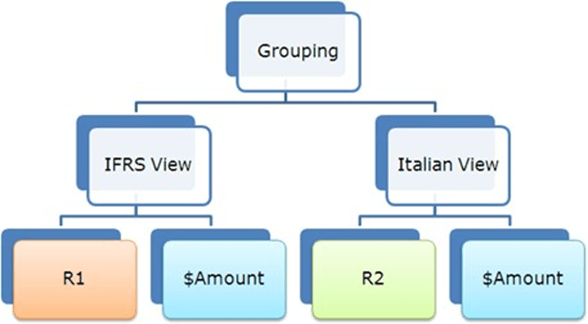
In this example, the default $AMOUNT category and two other categories allow for the classification of changes to the original data. Category R1 classifies the data based on the IFRS, while category R2 classifies it according to the national accounting standards. The categories can therefore be grouped based on two views: the “IFRS View” and the “Italian View”. These two classifications can coexist within the grouping.
Journal models
It is possible to define a journal model for each ‘Company Journal’ and ‘Consolidation Journal’ category, i.e. a list of accounts that are normally contained in the journal. When these models are used when inserting the journal, the required accounts will open automatically.