L/T Financing
Medium-/long-term financing represents all entries for the initial granting of the L/T financing, capitalisation and interest payments, repayment of the capital amount according to fixed or variable instalments, as well as more particular cases such as preamortisation, the financing project or the early repayment of the L/T financing.
L/T financing can be managed in several ways:
- by using the functionalities of the ETL module to load the data from any ERP system and in general from any IT system in which they are managed;
- from the end user’s web interface through the processes cockpit by selecting, from the Cash Flow Planning button, the menu item L/T financing within the Activity panel;
- from a workflow model task. The task to be used in this case is Data entry & Reporting > Cash Flow Planning, subsequently indicating the OBJECTS_L_T_FINANCING - L/T Financing in the parameters;
- from a transactional data entry form with custom ETL
All L/T financing is managed by process/entity.
The management of L/T financing can be subdivided into the following steps:
- definition of the general information related to the L/T financing, such as the account / custom dimension onto which the loan must be loaded, the counterparty entity in the case of intercompany financing, etc.
- management of the L/T financing conditions, such as the amount to be financed and the relative payment schedule for interest and the capital amount
- any management of:
- preamortisation
- early repayment
- interest rate hedging
- project Financing
- deployment and visualisation of the events deriving from the L/T financing defined
Definition of the general information on the L/T financing
Firstly, it is necessary to define the general characteristics of the L/T financing, namely its identification number, the account onto which it must be loaded, any other dimension (CDC, Product, etc.) to which it is to be attributed, etc.
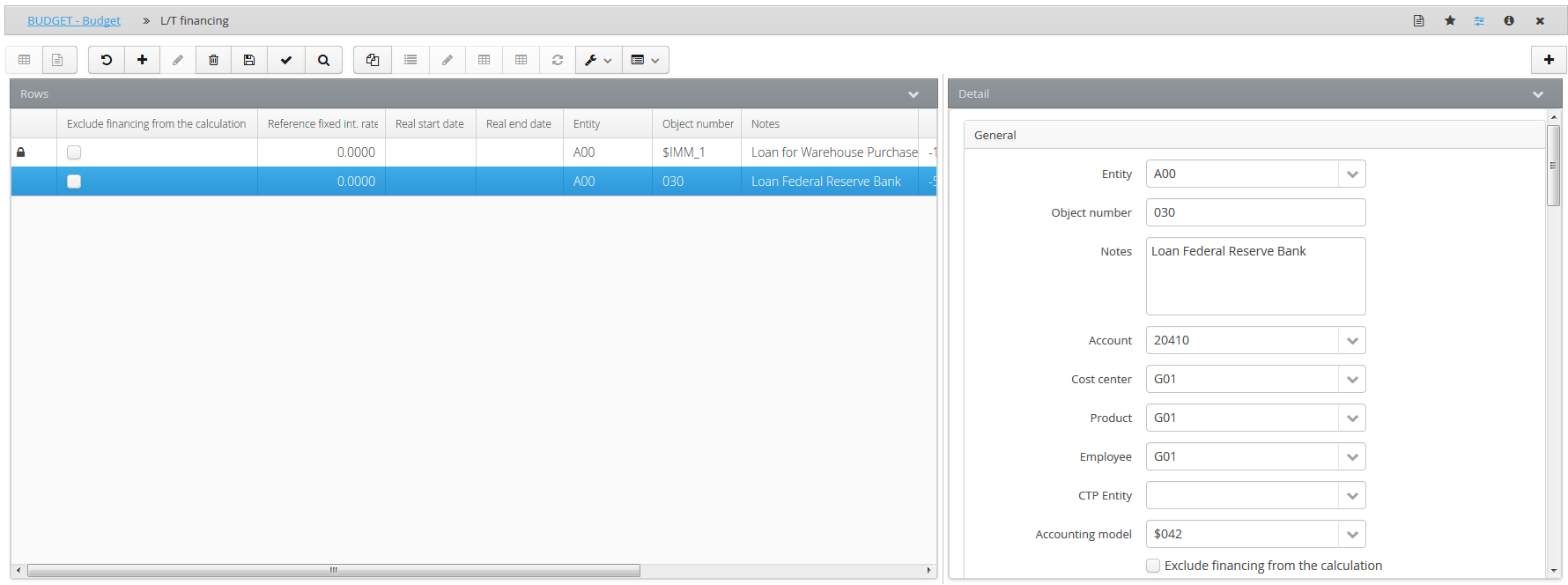
All L/T financing is identified by:
- a number which constitutes the L/T financing’s unique identifier
- a description contained in the description field
- an accounting model of an “L/T Financing” nature used by the system to generate the entries linked to the financing. It is possible to choose between a L/T financing payable or a L/T financing receivable. Based on the type of L/T financing, the system performs various calculations, especially in relation to the signs and the amounts incoming/outgoing to/from the bank, which characterise L/T financing as either receivable or payable.
- a derivative
- an account of a “balance sheet” nature used by the system to generate the entries linked to the L/T financing
- one or several custom dimensions (such as Products, Clients, Cost Centres, etc.), if their management is enabled
- a counterparty entity, for intercompany L/T financing. In such cases, all of the variations deriving from the management of the L/T financing will show the counterparty
- a custom counterparty dimension 2 for intercompany L/T financing and the relationship type for the process in question whether “For entity / custom dimension 2” or “For entity / Synthetic custom dimension 2”
 The Exclude L/T financing from the calculation field allows the user to decide whether or not to include the object in the calculation of the financing. This setting can be useful in the simulation phase whether or not the user wants to include the object without having to cancel it.
Management of the L/T financing conditions
Once the “ingredients” of the medium-/long-term financing to be managed have been defined, it is necessary to tell the system a series of information related to the amount to be financed and the related interest and capital payment schedule. In essence, it is necessary to tell the system the contractual conditions that the institution granting the loan has given the entity.
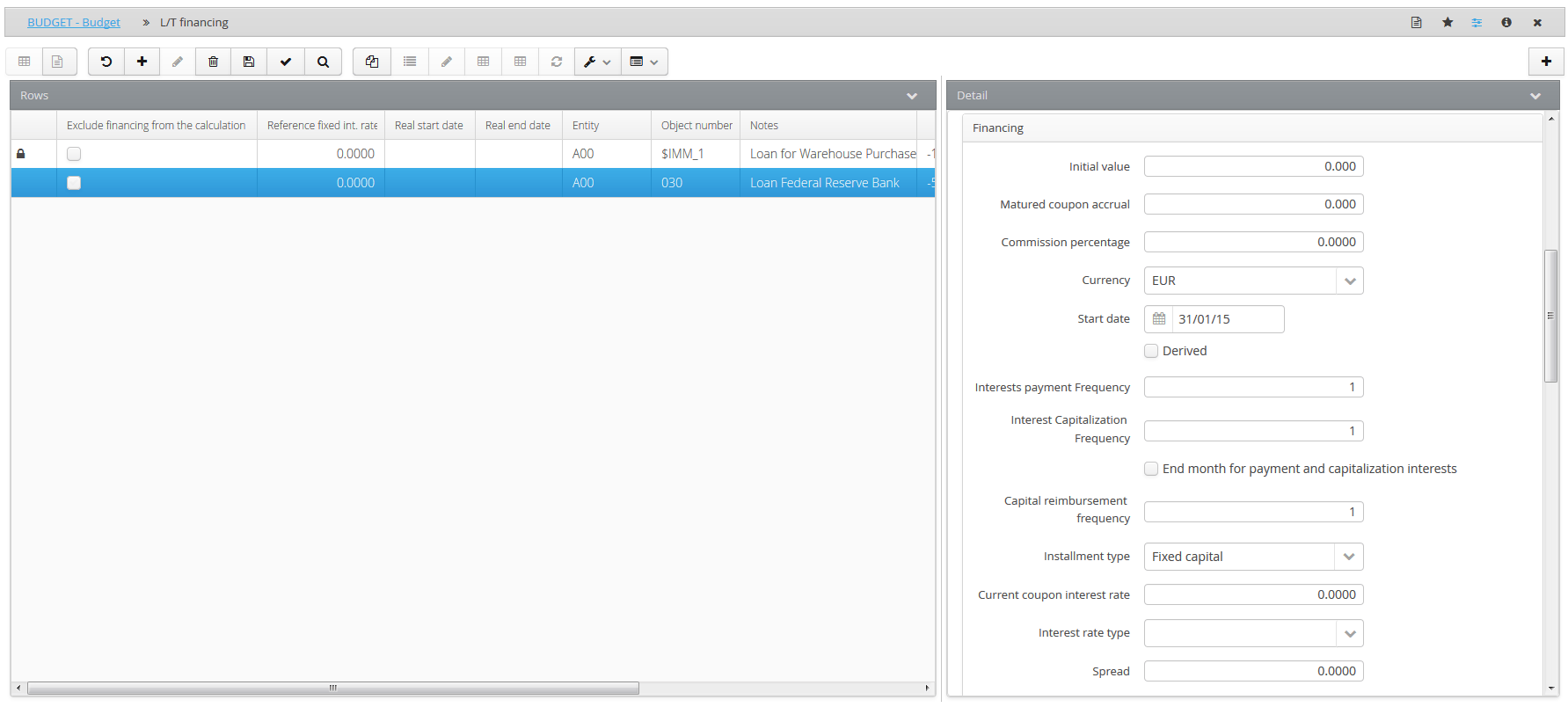
All L/T financing is identified:
- by the initial value, which indicates the overall value of the L/T financing granted
 The sign of the initial value is that stated in the accounts; therefore, L/T financing payable has a “-” sign, while a loan receivable has a “+” sign
- by the currency in which the L/T financing is opened
- by the start date, which indicates the date on which the loan is granted
- by the commission percentage to be applied to the initial value of the L/T financing
- by a matured coupon accrual. In the event that the object is a security with a coupon, indicate the amount of the interest instalment accrued from the date of the last coupon to the acquisition date
-
by a current coupon interest rate
-
by an end date. This date is always calculated automatically by the system and indicates the date on which the loan/L/T financing is paid in full. In cases of early repayment, the system does not calculate this date
- by the type of instalment, or whether the repayment of the L/T financing is done according to a “Fixed total managed by a rate” or by “Fixed capital” instalments. In the latter case it is also necessary to indicate the type of rate
- by any fixed rate, for fixed rate L/T financing
- for monthly variable rate financing, by a possible spread, i.e. a quota (positive or negative) to be applied to the monthly amount of the variable rate
By enabling the “Variable rate by period” option, it is possible to tell the system that the interest is calculated by applying, every month, the specific rates defined in the list (accessible from the administrator-user’s web interface, following the path: Generic Data and Events > Data > Interest Rates) for the rate type specified for the L/T financing. Then, rather than applying a fixed rate, the system applies a variable rate per month. Otherwise, the rate for the first monthly repayment instalment is applied for the whole period.
- by the frequency of interest payments which indicates how frequently, in months, the accrued interest on the L/T financing must be paid. Based on this information, the system automatically generates the payment entry
- by the frequency of interest capitalisation, which indicates how frequently, in months, the accrued interest on the L/T financing must be capitalised. Based on this information, the system automatically calculates the interest capitalisation
- by the frequency with which the capital instalments are repaid, which indicates how frequently, in months, the capital amount of the L/T financing must be repaid
- by the amount of the capital instalment, or the amount of the capital reimbursed every due date
- by the number of instalments that make up the loan repayment plan
- by the amount of the total instalment, i.e. the amount repaid periodically, for fixed-instalment L/T financing
- by the type of month used to calculate the interest, which indicates whether the month duration used for calculating the interest is “Commercial (30 days)” or “Calendar”
- by the type of month used to calculate the interest, which indicates whether the length of the year, in days, to be used as the denominator in the interest calculation is “Commercial (Commercial days / 360)”, “Mixed (Commercial days / 365” or “Calendar (Calendar days / 365)”
- by withholding tax percentage
- contract start date
- contract end date
- If the instalment type is “Fixed capital”:
- entry of the total instalment is disabled
- either the capital instalment or the number of instalments must be entered
- the initial value must be multiplied by the capital instalment
- If the instalment type is “Fixed total managed by rate”:
- the entry of the capital instalment, the rate type and the spread is disabled
- the total instalment or number of instalments must be entered
- the fixed rate must be entered
- It is not possible to enter the rate type or the fixed rate
In addition to the standard management of L/T financing, it is also possible to manage some particular cases. Let us look at what these are in detail.
Preamortization
Preamortisation makes it possible to pay the interest on the contracted L/T financing before it has been disbursed
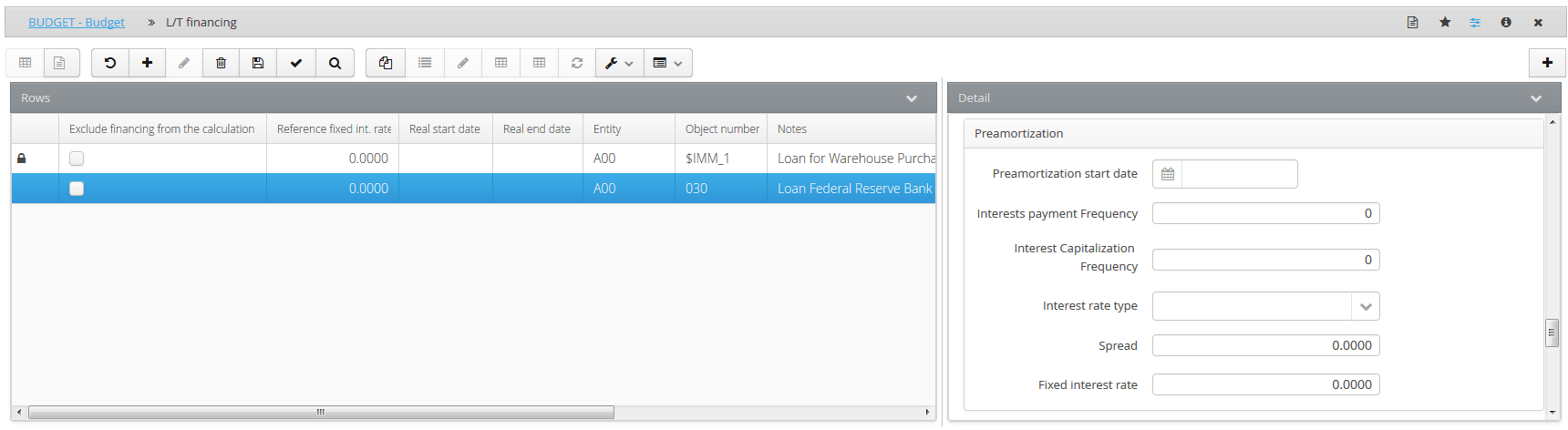
In cases of preamortisation, for all L/T financing it is necessary to specify:
- a preamortisation start date which is typically prior to the L/T financing start date
- a fixed rate / rate type / spread. As for standard L/T financing, in cases of preamortisation interest can also be calculated on the basis of a fixed or variable rate plus a spread which may or may not coincide with that granted when the L/T financing is disbursed.
- an interest payment frequency to tell the system how frequently, in days, the pre-amortisation interest payment entry must be generated
- an interest capitalisation frequency which indicates how frequently, in months, the preamortisation interest must be capitalised, so that the system can automatically perform that calculation
Early repayment
Early repayment makes it possible to repay part or all of the capital amount of the loan before the final due date, calculated on the basis of the regular repayment plan.
Early repayment management can be accessed directly from the Detail action, selecting the Early repayment folder.
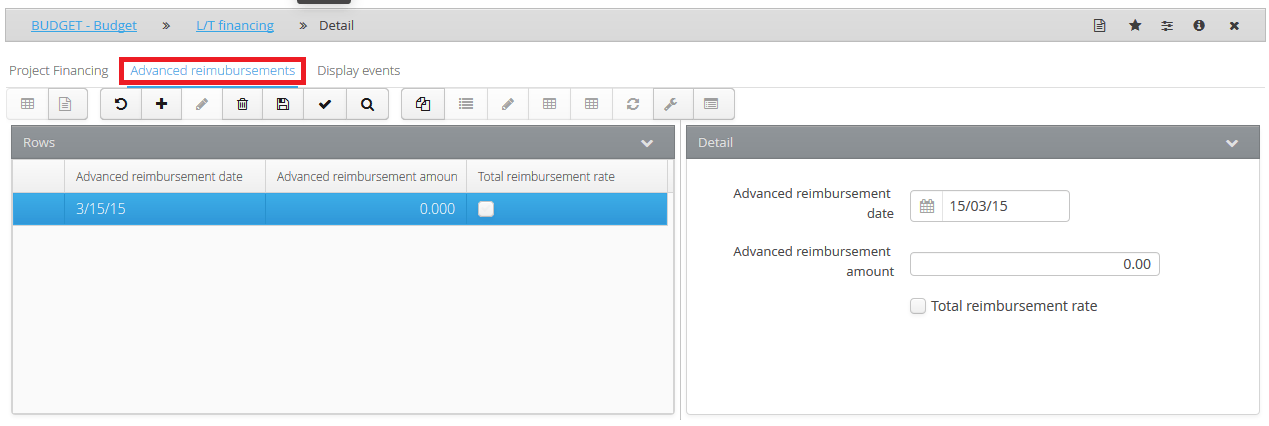
The information to be managed for L/T financing that entails early repayment concerns the choice of whether to perform a total repayment at a certain date or the repayment of a different amount, specifying the date on which to repay it. It should be taken into account that, in the latter case, the sign of the amount must be the same as the sign of the initial value of the L/T financing.
The repayment date must always be between the L/T financing start date and end date.
Interest rates hedging
Interest rate hedging is used in cases in which the entity has put in place a hedging instrument against the risk of increases in the market rates.
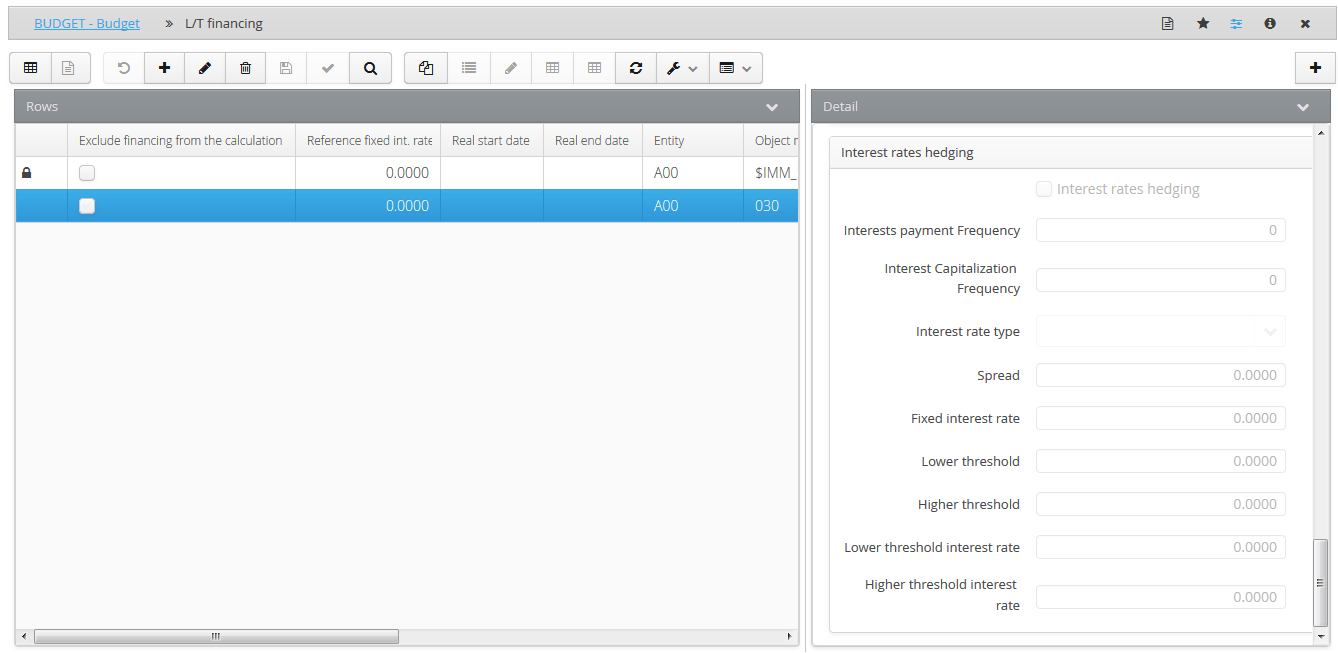
In cases of interest rate hedging, for all L/T financing it is necessary to specify:
- a fixed rate / rate type / spread. As for standard L/T financing, in cases of interest rate hedging, interest can also be calculated on the basis of a fixed or variable rate plus a spread which may or may not coincide with that granted when the L/T financing is disbursed.
- an interest payment frequency. Indicate how frequently, in days, interest must be paid for the interest rate hedge, so that the system can automatically generate the entry. This must be greater than zero where interest rates receivable are being hedged.
- an interest capitalisation frequency. Indicate how frequently, in days, interest must be capitalised for the interest rate hedge, so that the system can automatically perform that calculation. This must be greater than zero where interest rates receivable are being hedged.
- a Lower threshold, i.e. the lower interest rate limit
- a Lower threshold interest rate to be used for the calculation of the interest rate hedge where the rate is lower than the “lower threshold”
- a Higher threshold, or the upper rate limit
- a Higher threshold interest rate to be used for the calculation of the interest rate hedge where the rate is higher than the “higher threshold”.
To tell the system that the L/T financing performs the calculation of the interest rate hedging, it is necessary to enable the Interest rate hedging option.
Project Financing
Project financing allows the user to defer the final due date for L/T financing that is currently underway. The typical case concerns the need to renew the L/T financing in question beyond its natural final due date, without giving rise to new L/T financing, while keeping the conditions of the loan taken out previously unchanged.
By indicating the date and the amount to be renewed, the system increases the value of the loan in accordance with the specified amount and readjusts the basis of calculation for the L/T financing thus renewed.
Project financing management can be accessed directly from the Detail action, selecting the Project Financing folder.
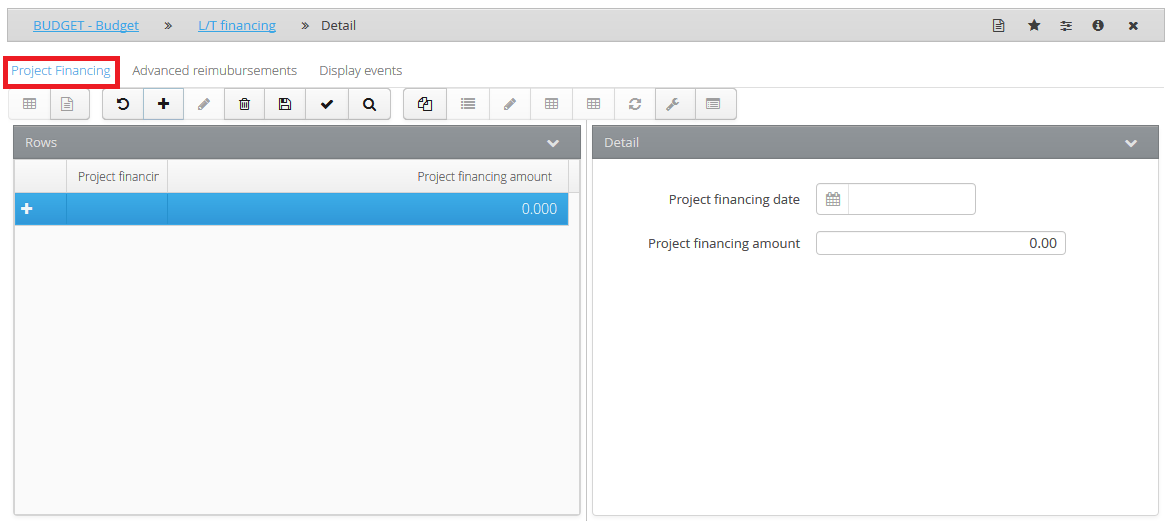
The information to be managed is the following:
- the Project financing date. This date must be between the “preamortisation start date” and the L/T financing “start date”.
- the project financing amount
Having finished the setup, it is possible to view all of the events deriving from the management of the L/T financing via Actions ( ) > Detail in the View Entries folder
It is possible to update the details to make them adopt any changes made via Utility ( ) > Data processing
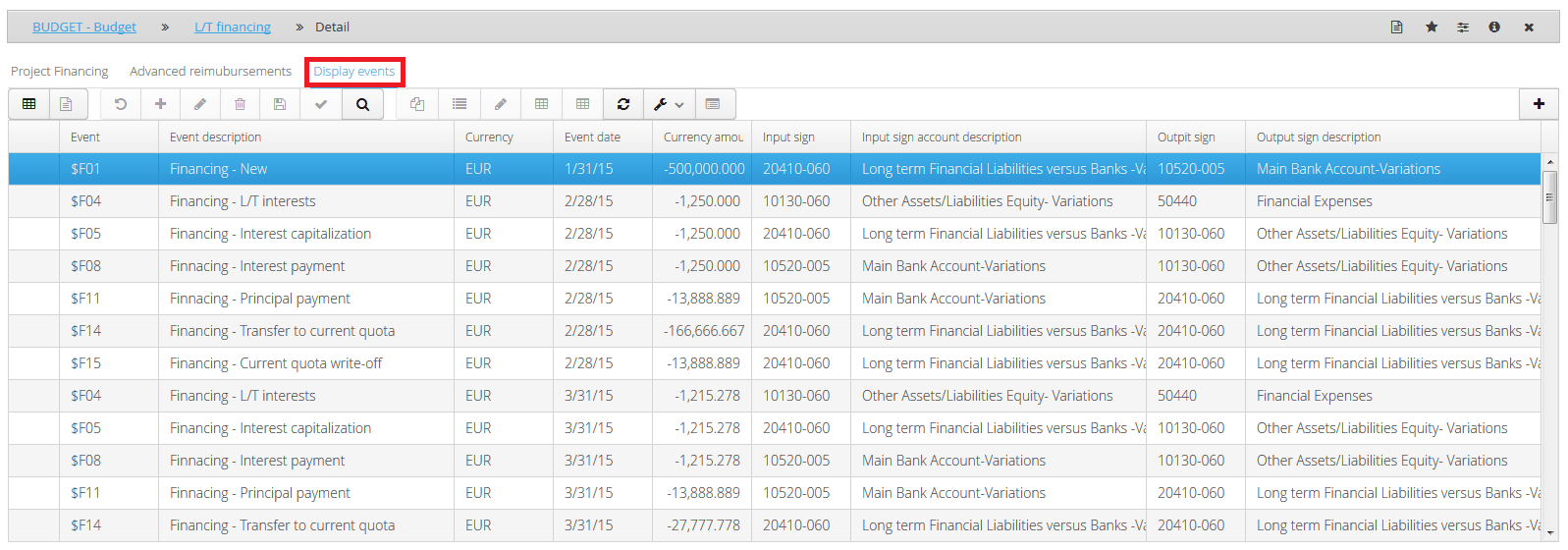
The system displays all the events deriving from the setup of the L/T financing that has been chosen, but not the double entries, which will instead be created upon the general launch of the simulation.
The system displays (based on the event date) all the events related to the defined L/T financing plan, and reports a series of information for each of them, such as:
- the currency
- the currency amount
- the reference account (Input sign) for that particular type of accounting (opening the L/T financing, capital amount repayment, interest payment, etc.)
- the account used as the contra-entry (Opposite sign)