Cash Flow Planning
In Tagetik, Financial Planning is managed through the “Cash Flow Planning” process which, at both the company and group levels, is able to manage the following:
- balance sheet forecasts (both short-term and medium/long-term);
- direct and indirect cash flow forecasts (through the processing of cash flows);
- depreciation, financial and fiscal expenses and income which form part of the P&L account forecasts;
- management and simulation of the forecast financial policy, also taking account of any group policies (forecast cash pooling);
- “multicurrency” simulation with calculation of the forecast currency balance, and also the possibility of performing hedging transactions;
- “what if” analyses of various simulation scenarios.
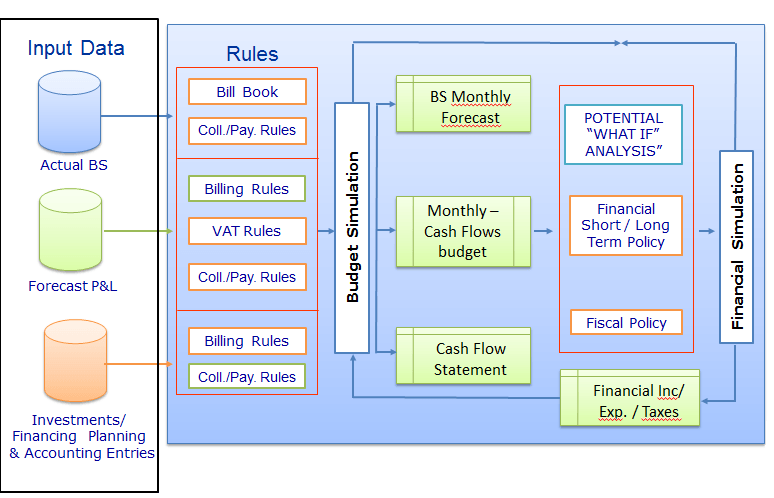
Based on the most recent available balance sheet, P&L forecast and investments and financing forecast, Tagetik allows the user to associate financial rules (DSO/DPO, non-accrual based billing, etc.) with each input item and, by creating forecast double-entries, to achieve initial processing of balance sheet and cash flow forecasts.
Having viewed the variations generated by the system, it is possible to manage various “financial policy” scenarios to cover any needs or invest the liquidity generated.
The system also allows users to define the tax policy to pursue to generate tax forecasts for the period. At this point, the Cash Flow Engine is able to complete the budget P&L (input from the system) with an estimate of depreciation, financial and tax expenses and income and guarantee perfect balancing, with the generation of double-entries, between balance sheets, cash flows and P&Ls.
Loading input data
The necessary initial data are as follows:
- the initial balance sheet. This is identified by the actual balance sheet values related to the closing date of the last available financial statements;
- the projected P&L . The forecast P&L values are necessary up to at least the EBITDA, since everything that is below that margin (depreciation, short- and long-term financial expenses/income, taxes etc.) can be calculated directly by the system.
 Normally, depreciation related to existing assets is also loaded as input data.
- the investments/L/T financing forecast and other management accounting entries (such as dividend distribution, capital increases, etc.).
Definition of financial rules
It is necessary to define:
- the financial rules to be associated with the initial balance sheet accounts for which collections/payments are to be recorded, such as initial receivables and payables, for example. The system envisages two possible criteria:
- the cash schedule, in which the dates on which the collections and payments are forecast to be made are shown directly. If the schedule entered is considered to be theoretical, it is also possible to apply the percentages outstanding or unpaid, delaying the payments themselves or not collecting part of the payments;
- the credit terms rule, in which a percentage payment is indicated together with the due date, making reference not to an actual date, but a number of days/months from the start of the simulation;
- the financial/VAT rules to be associated with the P&L forecasts.
- the credit terms (DSO/DPO) which generate the cash movements that impact the calculation of the financial position (e.g. 30% at 60 days, and 70% at 90 days);
- if the accruals basis gives different results from what is stated in the accounts, it is also necessary to define the accounting rules that generate the movement of receivables/payables in the balance sheet forecast (e.g. six-monthly advance billing, quarterly billing in arrears, etc.). Then the DSOs/DPOs defined in the previous point will be applied to that curve;
If the account does not need to be directly linked to a cash movement (e.g. depreciation), the system reverses the amount on the balance sheet account defined as the contra-entry on the list.
- moreover, if the account is subject to indirect tax, it is necessary to define the VAT rate to be applied, so that it is possible to determine the company’s position in relation to the tax authority.
- the financial rules to be associated with investments/L/T financing and other management accounting entries.
The same rules (credit terms, accounting and VAT) as defined for managing the P&L forecasts are used.
Launch budget simulation
Considering the initial balance sheet, the P&L forecast and the forecast of L/T financing and investments as the basis, and applying the financial rules defined above, the budget simulation (create entries) feeds:
- the balance sheet forecast
- the cash flow forecast with the variations generated by the financial rules set
- the P&L forecast with an estimation of the depreciation of the hypothesised investment forecasts and medium/long-term expenses related to the L/T financing
Financial policy management
The rules for calculating interest must be defined in order to be able to determine, on the basis of the liquidity generated, the net financial position inclusive of short-term expenses and financial income, at both company and group levels.
Tax policy definition to be applied
For each tax levied under the fiscal policy for an entity, the rates to be applied and the tax rules (e.g. the due dates for the various payments on account and balance payments) must be defined, as information needed by the system to calculate the direct taxes due for the year.
Launch financial simulation and tax calculation
The financial simulation and direct taxes calculation feed the P&L with short-term interest (result of the financial policy set), depreciation and direct taxes for the year.
Financial planning in Tagetik also allows the user to perform “what if” simulations aimed at assessing:
- the P&L, balance sheet and financial impact of different business strategies
- the sustainability of various financial hedging policies
- the sustainability of various tax policies
The forecast data entered in the system (via the internet or using data entry forms) or generated automatically from the processing of financial planning data can be viewed using output forms.
Certain information can be retrieved by using specific system reports, some of which can be downloaded in .pdf format (e.g. the financial policy report) and others in .xls format (e.g. those which illustrate the changes in the VAT position, tax burden and group entries).
Overview of the Cash Flow Planning Module
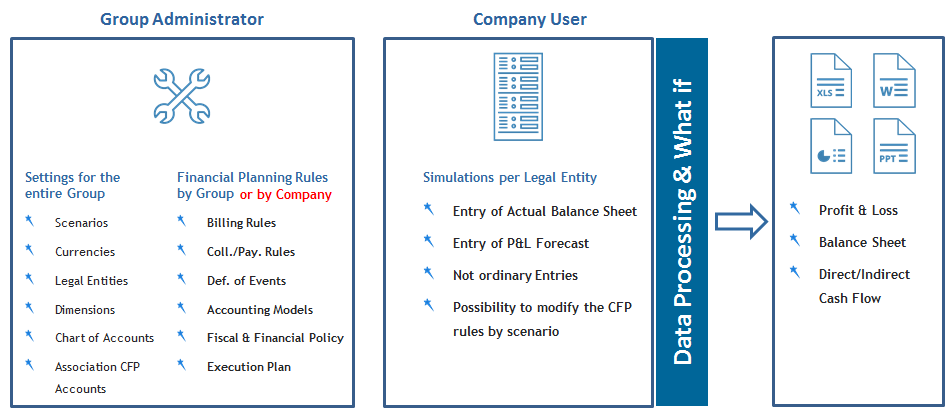
Financial planning operates from a group perspective. It is possible to set the financial rules and credit terms that are valid for all group companies and customise them for each individual entity.
Group administrator activities
The group administrator is responsible for the following areas:
- Administration. This includes the setup of the basic information needed for the planning process, i.e.:
- Data Model: necessary for the definition of the standard lists, important for all the processes used in Tagetik and also, therefore, the planning process (chart of accounts, currencies, dimensions, etc.).
- Processes: necessary for the definition of the planning process and the entities to be processed
- Generic data and events: necessary for the management of “global assumptions”, or that data which is linked to the process but independent of the individual entity, such as exchange rates and tax rates
- Rules. This includes the setup of the rules needed to generate the values forecast, i.e.:
- Cash Flow Planning Rules: defines all the financial planning rules which can be valid for all entities belonging to a given group (DSO, DPO, etc.) or specific to the individual entities
- Tax Rules: defines the rules related to the treatment of direct taxes
Activities of an individual company’s financial manager
The financial manager of an individual company can:
- enter or change the specific credit terms for his company
- customise the financial rules associated with the input data
- enter the input data (initial balance sheet, projected P&L, forecast of investments/L/T financing and other accounting entries related to management)
- perform the budget simulation (Create Double entries), which defines the balance sheet and relative cash flows
- perform the financial simulation and calculation of direct taxes which enters amounts for financial charges, depreciation and tax expense to the P&L.