About Forecasting with CCH Tagetik Supply Chain Planning
The use of forecasting as a business decision-making tool has been around since the dawn of commerce. Over time, forecasting has evolved into a precise mathematical science that is highly valued for budgeting, strategic planning, and estimating future growth and revenue. Essential as forecasting is to business planning, it is often confused with setting targets and budgeting.
Forecasts, targets, and budgets are entirely different tools in business with very different purposes:
Types of Business Tools
| Business Tools | Description |
|---|---|
| Forecasting | An objective projection of what is actually going to happen based on historical evidence. |
| Targeting | A goal for sales staff set by an executive based on best guess conjecture with a limited connection to what is actually going to happen. |
| Budgeting | An expense- or finance-oriented plan often derived from targets and designed to cover expenditures needed to achieve a particular goal. Figures are not based on real data. |
A forecasting scenario includes the following steps using CCH Tagetik Supply Chain Planning:
- Create a forecast.
Start your planning process by building an objective forecast using past trends, historical data, business insight, and statistics. 2. Derive a target.
Derive your targets by testing ideas and trying strategies, including those that have never been done before. You can accomplish extraordinary things by exercising your forecast to find the best predictions and most likely outcomes before you make a decision and implement it. 3. Plan a budget.
Once you define a target, based on the forecast’s projections, you can establish a budget to help you achieve your goal.
Forecasting Methods and Applications
CCH Tagetik Supply Chain Planning provides the following forecasting methods:
Forecasting Methods
| Methods | Description |
|---|---|
| Time-series forecasting | This is useful for short-term forecasting and determining seasonal patterns. This method requires historical data. Time-series forecasting relies on the assumption that you can extract a trend from historical data and extrapolate the trend into the future. For example, use historical sales to predict future sales. This is a very useful technique for short-range forecasts because it is easy to apply. In addition, in the absence of any substantial change in business practices, time-series forecasts can be quite accurate. See Time Series Forecast Record. |
| Model-based forecasting | Useful for long-term forecasting, accounting for changes in your business environment and events for which there is little to no historical data, such as implementing a new marketing promotion. Model-based forecasts are used to exercise and compare competing business plans. These forecasts are fundamentally different from time-series forecasts in that you intend to change your business practices. Therefore, extrapolating past performance is no longer a good predictor of future performance. Strategic forecasts rely on modeling and simulation techniques rather than statistical data analysis. A good example of Model-based forecasting is an Adoption model. Adoption models (sometimes called Diffusion models or S-curves) are used to forecast the adoption of new products or technologies. These models are useful for long-range forecasting where product life cycle effects are prominent. For example, an Adoption model can project the number of units that will be sold over a set period as in the release of a new product, which starts to sell slowly due to several factors, then goes through a rapid growth period, followed by slow sales due to market saturation. See Adoption Record. |
The important distinction to make is time-series forecasting is a tactical forecasting method whereas model-based forecasting is a strategic forecasting method.
Forecasting Comparison
| Time-Series | Model-Based | |
|---|---|---|
| Purpose | Tactical | Strategic |
| Based on | Historical data | Management insight |
| Methods | - Exponential smoothing - Statistical regression - Fourier analysis | - Monte Carlo simulation - Decision analysis - Stochastic optimization |
| Used for | - Production planning - Inventory management - Sales force evaluation | - Marketing strategy - Resource allocation - Business optimization |
Forecasting Misconceptions
One of the most common misconceptions about forecasting is the forecasting method with the best fit, as measured by the Symmetric Mean Absolute Percent Error (SMAPE), is the best method. This is not true. Some forecasting methods might have extremely low SMAPE values, which indicate a near perfect fit to the historical data. The problem is the method might be fitting randomness or noise in your data that should not be extrapolated. The best methods extract only true trends hidden in the data.
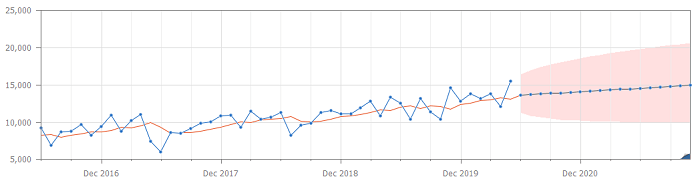
Another common misconception about forecasting is straight-line forecasts are poor forecasts because your data is not a straight line. Your data usually has inherent variability, making it jump around. Sometimes the variability exhibits a trend or pattern and sometimes it is just noise. CCH Tagetik Supply Chain Planning looks for the trends and patterns that actually exist. In the absence of real patterns, the best forecast might be a straight line.
Straight Line Forecast