The matching process
Introduction
In CCH Tagetik, the term “matching” means the process of balancing intercompany entries between companies in the same group. Matching therefore represents an attempt to make the amounts that a declaring entity presents to a counterparty entity consistent with the corresponding amounts that the counterparty presents to the declaring entity.
Matching, together with the elimination of intercompany entries, is one of the fundamental processes for consolidation and can be carried out thanks to the definition of dedicated logics; see Matching logics and intercompany elimination.
Matching and eliminations ensure that transactions between controlled entities in the same group are not presented at the consolidated level
The matching process can start when all the IC declarations that can be inserted have been inserted. If the relationship between the two entities is not correctly balanced, the managers of the two entities must collaborate to ensure that relationship respects the previously defined balancing rules.
Example
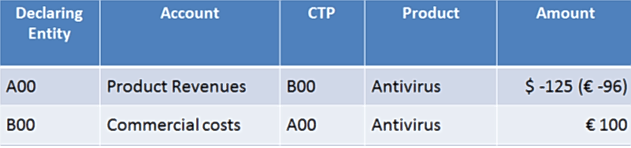
In this example, entity A00 has sold “Antivirus” products worth $ 125 (around € 96 at the current FX rate) and entity B00 has declared a purchase cost of € 100 to A00. Generally, this happens between two entities in the same group and generates an unbalanced elimination journal. The relationship between A00 and B00 can be balanced in two different ways.
| If... | Then... |
|---|---|
| one of the two entities has made an error. | one or both of the amounts must be corrected. |
| the data are correct for both entities. | the missing amount must be inserted in a special account (Reconciliation accounts) that justifies the unbalanced amount in the IC relationships. |
In this example, the difference of € 4 can be identified as the “FX rate difference”: B00 has declared a cost of € 100 for each purchase of the antivirus product but A00 has declared a profit of € 96 because it registered the amount on a different day with a different FX rate. Therefore, both of the amounts are correct and the unbalanced amount is due to an external factor.
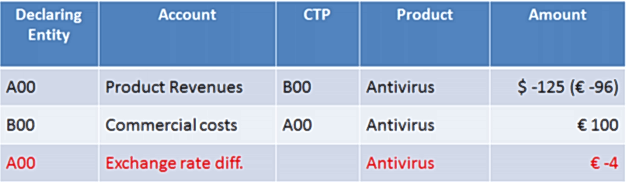
IC matching details
Matching can be done according to one of the following methods:
| Relationship type | Description |
|---|---|
| By Entity | Matching is done at the entity level. In the IC cockpit, the individual entities involved in the relationships between entities are listed. |
| By Entity / Custom dimension 2 | Only visible if the Relationship Type is Entity/Custom dimension 2 for the data collection process. Allows you to match the intercompany entries at a more detailed level than the entity level. For example, for entities that operate in different sectors where the consolidator needs to produce aggregated data for each line of business. The data included in the IC declarations are collected by also specifying the line of business from which the revenues or expenses are obtained. The IC cockpit displays not only the individual entities in the relationship but also the specific custom dimensions 2 items. |
| By Entity Node | Matching is done at the node level instead of by individual entity. The nodes used for this analysis are those of the first level of the entity hierarchy associated with the process. The IC cockpit displays the entity nodes and not the individual entities. All the entities of the node are therefore detailed in the management page (IC entry management page). |