Periodic calculation and change of consolidation criteria
Periodic calculation of consolidable data
This calculation copies the data from the previous periods for the following accounts and adds it according to the correct amount for the data processing period:
- Profit & loss accounts
- Other variation accounts
- Variation accounts
- Normal net result account in the Balance Sheet
To identify the previous period, the period length set on the consolidation scenario period is considered.
Change of consolidation criteria
Some examples related specifically to the valuation of the financial investment are provided below.
Example of changing from Equity to Line-by-line
Amounts and journals
From the first period in which the company is valued according to the Line-by-line method, CCH Tagetik proceeds as follows:
- Profit & loss accounts: the part that was originated in the period is considered
-
Balance sheet and other stock accounts:
-
Normal and detail accounts are considered according to their cumulated amounts.
- The part of variation accounts that was originated in the period is considered.
- The amount of the variation accounts from the previous period (in which the entity was valued at equity) is allocated to the change to/from the equity method variation in Entrance or Entrance/Exit defined in the control group. The origin of these rows is CONS_EQUITYEVAL_CHANGE.
- The part of the BS period Net result account that was originated in the period is considered, or is adjusted to the P&L result calculated according to the periodic method. The difference between the cumulated calculation and the periodic calculation is allocated to the contra-entry account to align the balance sheet result with the profit and loss result defined in configuration for the Proportional and Consolidable data calculation data processing. The origin of the change to/from the equity method rows for the balance sheet result is CONS_EQUITYEVAL_SP_RESULT.
- The part of the minorities Balance Sheet Net result account that was originated in the period is considered. The minorities balance sheet result from the previous period is allocated to the minorities account related in the minorities rules to the contra-entry account to align the balance sheet result with the profit and loss result. The origin of these rows is CONS_EQUITYEVAL_SP_RESULT.
Financial investment valuation
The Financial investment elimination journal is generated periodically following the generic rule. From the first period in which the owned entity is valued according to the line-by-line method, CCH Tagetik behaves as above for amounts and journals. This means that if the journal present on the original scenario has a P&L effect, only the portion of this that arose in the entity’s contribution period is allocated to the journal. The difference between the P&L net result and the BS net result is allocated to the account for the alignment defined in configuration for the Proportional and Consolidable data calculation data processing.
The Equity evaluation journal on the consolidable data is copied from the previous period to maintain the effect of the P&L account related to the revaluation/write-down. The financial investment and reserve accounts are written off. The variation accounts from the previous periods are written off by generating a row on the change to/from the equity method variation defined in the control group. The balance sheet net result account contains the result from the previous period (in which the entity was valued at equity). To keep the journal balanced, CCH Tagetik adjusts the account which, in the carry forward rules configuration, is defined as the carry forward for the Net result account.
In more detail, from the first period in which the entity is valued according to the line-by-line method, CCH Tagetik behaves as follows:
- P&L accounts: contain the amount copied from the previous period
-
Balance sheet and other stock accounts:
-
The normal and detail accounts contain the carry forward and the write-off. The total value is zero.
- The variation accounts contain the initial balance and the value copied from the previous period.
- The amount of the variation accounts for the initial balance and previous period (in which the entity was valued at equity) is written off on the change to/from the equity method variation in Entrance or Entrance/Exit defined in the control group. The origin of these rows is CONS_EQUITYEVAL_CHANGE.
- The Balance Sheet Net result account contains the amount copied from the previous period (in which the entity was valued at equity). This value is written off in the account defined as the carry forward of the Balance Sheet Net result in the carry forward rules. The origin of these rows is CONS_EQUITYEVAL_SP_RESULT.
- The minorities Balance Sheet Net result account contains the amount copied from the previous period. This value is written off in the account defined as the carry forward of the minorities Balance Sheet Net result in the carry forward rules. The origin of these rows is CONS_EQUITYEVAL_SP_RESULT.
The choice of carry forward account is linked to the need for the equity journal to be exhausted within the year. By using the net result carry forward account during the carry forward data processing, the journal will be eliminated as its total will be zero.
Below is a diagram of how the Profit and Loss part of the change of consolidation criteria from Line-by-line to Equity is managed.
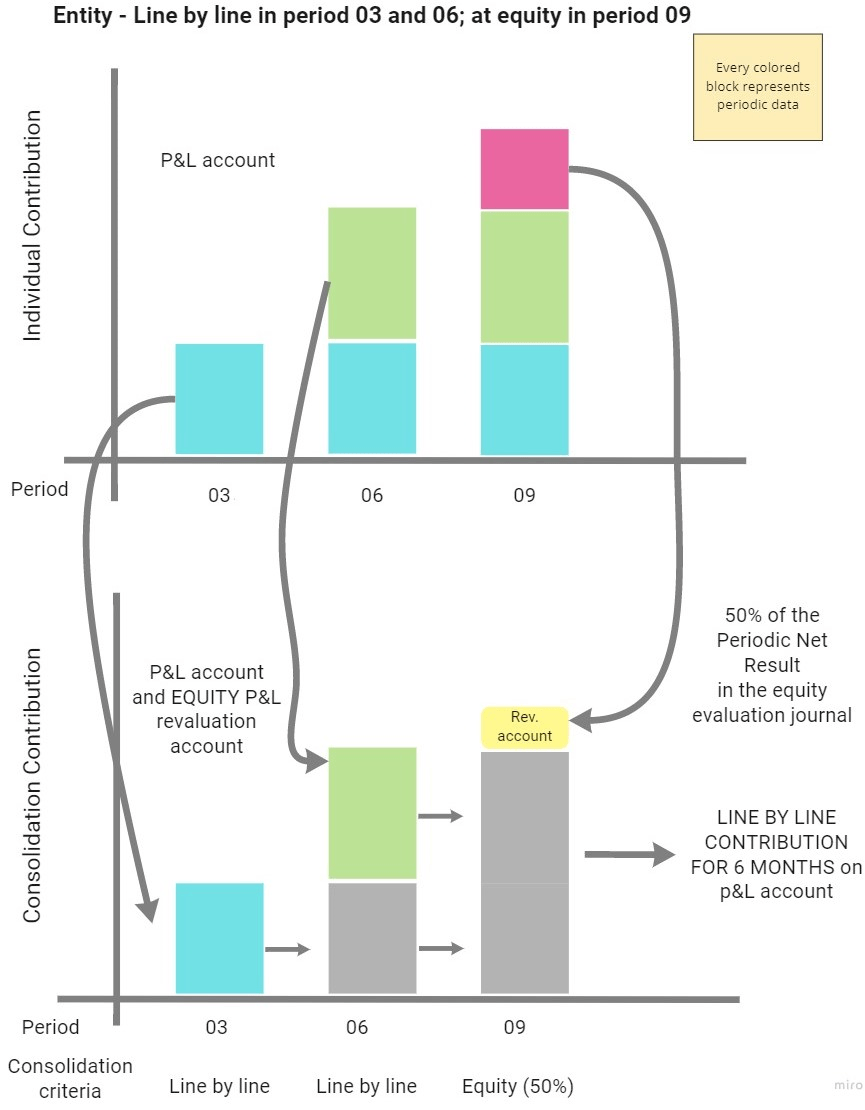
Example of changing from Line-by-line to Equity
Amounts and journals
CCH Tagetik copies the values of the profit and loss accounts and the balance sheet and other stock variations onto all periods subsequent to the one in which the entity is valued according to the line-by-line method. The amount of the variations copied from the previous period is written off by generating a row on the change to/from the equity method variation defined in the control group. The normal profit and loss accounts are not copied, with the exception of the Balance Sheet net result (of the opposite amount and sign as the P&L net result) and, when balancing, the carry forward account for the BS net result account.
In more detail, from the first period in which the entity is valued according to the equity method, the system behaves as follows:
-
P&L accounts: contain the amount copied from the previous period.
-
Balance sheet and other stock accounts:
-
The normal and detail accounts are not copied from the previous period; therefore, no rows are present on the amounts, while the carry forward and the write off are present on the journals. The total value is zero.
- The variation accounts contain the initial balance and the value copied from the previous period.
- The amount of the variation accounts for the initial balance and previous period (in which the entity was valued according to the line-by-line method) is written off on the change to/from the equity method variation in Entrance or Entrance/Exit defined in the control group. The origin of these rows is CONS_EQUITYEVAL_CHANGE.
- The Balance Sheet Net result account contains the amount copied from the previous period (in which the entity was valued according to the line-by-line method). This value is written off in the account defined as the carry forward of the Balance Sheet Net result in the carry forward rules. The origin of these rows is CONS_EQUITYEVAL_SP_RESULT.
- The minorities Balance Sheet Net result account contains the amount copied from the previous period. This value is written off in the account defined as the carry forward of the minorities Balance Sheet Net result in the carry forward rules. The origin of these rows is CONS_EQUITYEVAL_SP_RESULT.
Financial investment valuation
The Financial Investment Elimination journal is treated as indicated above for amounts and journals; therefore, it is copied from the previous period to carry forward the P&L accounts and written off for the balance sheet accounts. The contra-entry for the write-off of the balance sheet net result account is the configuration account for the carry forward of the net result defined in the carry forward rules.
The Equity evaluation journal arises in the first consolidation period in which the entity is valued according to the net equity method. The revaluation of the financial investment account only considers the contribution to the net result that was originated in the period.
In more detail, from the first period in which the entity is valued according to the equity method, the system behaves as follows:
-
Profit & loss accounts: the part that was originated in the period is considered
-
Balance sheet and other stock accounts:
-
Normal and detail accounts are considered according to their cumulated amounts.
- The part of variation accounts that was originated in the period is considered.
- The amount of the variation accounts from the previous period (in which the entity was valued according to the line-by-line method) is allocated to the change to/from the equity method variation in Entrance or Entrance/Exit defined in the control group. The origin of these rows is CONS_EQUITYEVAL_CHANGE.
- The part of the BS period Net result account that was originated in the period is considered, or is adjusted to the P&L result calculated according to the periodic method. The difference between the cumulated calculation and the periodic calculation is allocated to the contra-entry account to align the balance sheet result with the profit and loss result defined in configuration for the Proportional and Consolidable data calculation data processing. The origin of the change to/from the equity method rows for the net result is CONS_EQUITYEVAL_SP_RESULT.
- The part of the minorities Balance Sheet Net result account that was originated in the period is considered. The minorities balance sheet result from the previous period is allocated to the minorities account related in the minorities rules to the contra-entry account to align the balance sheet result with the profit and loss result. The origin of these rows is CONS_EQUITYEVAL_SP_RESULT.
Below is a diagram of how the change of consolidation criteria from Line-by-line to Equity is managed as far as the Profit and Loss part is concerned.
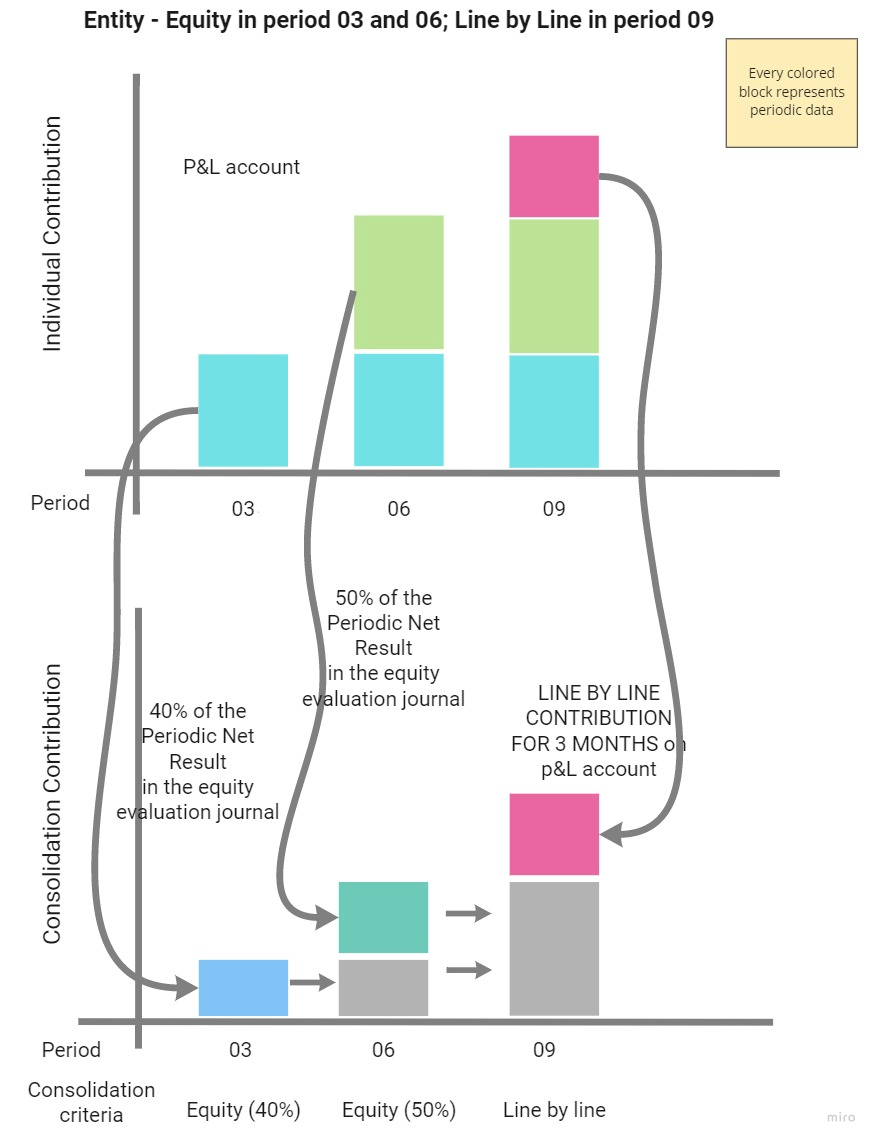
Preconditions
To obtain the correct periodic values, the entity data, including the journals, must be present on the original scenario, in the period prior to its entry into the consolidation area. This normally happens when the entity in other consolidation areas was already consolidated line-by-line/proportionally in the previous period.
However, if the data are not present, the following will happen:
- CCH Tagetik returns the results as if the calculation had been cumulated.
- To have the periodic calculation, you must insert the data on the previous scenario and run certain data processing (e.g. counterparty eliminations) to have the data, amounts and journals with which the system can calculate the periodic figure as the difference.
If the data are only partially present – for example the financial statements of the entity at Equity or at Cost and the Intercompany declarations but not the Intercompany eliminations exist in the previous period – you must insert only the periodic part of the IC declarations in the data processing period. Otherwise, there could be incorrect contributions on the accounts of entities that were valued using the at Equity or at Cost method in the previous period.