Equity evaluation data processing
Introduction
The equity evaluation data processing generates new financial investment equity evaluation journals based on the amounts and journals present on the converted amount type.
Based on the rule according to which an entity’s impact on the consolidated net equity does not change as the consolidation method changes, to generate the equity evaluation journals CCH Tagetik checks the impact of all that relates to an entity valued at equity on the consolidated net equity, on the converted amount type. Therefore, it generates a new consolidation journal with the financial statements, the entity journals and the net equity elimination journals and the minorities calculation. These journals only contain values on the consolidable amount type.
Equity evaluation journals
This journal contains the following data:
- Net equity of the entity at equity with financial investment contra-entry, with any separate statement of goodwill on a specific financial investment account.
- P&L net result of the entity at equity
- Any P&L accounts to keep on the equity evaluation journal
The entity on which to generate the rows of the equity evaluation journal is chosen based on the Entity on which to generate equity evaluation journals parameter defined in the equity evaluation rules (see Equity evaluation rules page).
The financial investments account to be adjusted on the at equity evaluation journal is read from the financial statements of the owner entity on the original scenario (intercompany amounts and entity journals). If several financial investment accounts not excluded from the equity evaluation in the equity evaluation rules (Financial investments accounts to exclude) are involved in the financial statements (the financial investment has a gross value and a write down fund), then CCH Tagetik chooses the one with the highest code.
Note: the financial investment accounts are normal balance sheet accounts with the Use account for setup attribute set to Financial investment.
If the account is not identified in the financial statements, then the account indicated in “Generic financial investments” in the general equity evaluation rules is used.
If the chosen financial investments account is different from that of the previous fiscal year, CCH Tagetik reclassifies the value of the old account in the new one when carrying forward. The flows used are the ones configures for Reclassification for changed account on equity evaluation method in the control groups of the financial investment accounts (see .
If there are several owner entities, the calculation of the impact of the entity at equity’s data on the consolidable amount is performed for each individual owner entity.
The proportion with which the calculation is performed is obtained from the table of at equity owner entities in the consolidation area. The proportional percentage of the entities valued at equity is subdivided among the line-by-line or proportional owner entities themselves. The distribution is performed by applying different percentages for the group accounts and the minorities accounts:
- for the group: % indicated in the table of at equity owner entities * owner entity equity ratio % / 100
- for the minorities: % indicated in the table of at equity owner entities * (owner entity proportional % - owner entity equity ratio %) / 100
If a “dummy” equity evaluation is necessary, the distribution among the owners is performed by applying the group % to all accounts, including the minorities:
group % = % indicated in the at equity owner entities * owner entity equity ratio % / 100
Note: This avoids generating unbalanced journals if the group % is different from the minorities %.
Example
A and B are line-by-line parent entities and C is an entity at equity
The group is distributed based on the following coefficients:
- On A: %AC * A’s equity ratio %
- On B: %BC * B’s equity ratio %
Minorities are distributed based on the following coefficients:
- On A: %AC * (A’s proportional % - A’s equity ratio %)
- On B: %BC * (B’s proportional % - B’s equity ratio %)
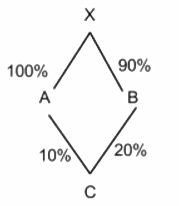
C’s proportional percentage is 30% (10% + 20%).
C’s equity ratio percentage is 28% (20 * 90% + 10 * 100%)
If C’s net equity is -10000, the following consolidated net equity is obtained:
- Group net equity -2800 (10000 * 28%)
- Minorities net equity -200 (minorities % = 30% - 28% - 2%)
A’s equity ratio percentage in C and B’s equity ratio percentage in C present in the deployed table of owner entities at equity are:
- AC 10%
- BC 20%
For the group, the data processing reproportions the following percentages to 100%, dividing them by the total of the percentages:
AC (10*100%/28) * 100 = 35.714%
BC (20*90%/28) * 100 = 64.286%
For minorities, the data processing reproportions the following percentages to 100%, dividing them by the total of the percentages:
- AC (10*(100%-100%)/2) * 100 = 0%
- BC (20*(100-90)%/2) * 100 =100%
Therefore, the following distribution of C’s group and minorities net equity on owner entities A and B is obtained:
- A
- Group net equity = 2800* 35.714% = 1000
- Minorities net equity = 200 * 0% = 0
- B
- Group net equity = 2800* 64.286% = 1800
- Minorities net equity = 200 * 100% = 200
Changes compared with the previous scenario/period
CCH Tagetik treats the changes between the scenario/period to be processed and the previous scenario/period considering the following elements:
- categories equity evaluation rules (changes in accounts are not considered)
- entity consolidation type
- equity evaluation method and Many to many relationship attribute for consolidation journals
- owner entities of the entity at equity
- equity ratio percentage and proportionality ratio percentage of the owner entities of the entity at equity
The changes are considered in order to generate the relative adjustments to correct the previous scenario/period amount. For normal and detail BS and other stock accounts, changes to the variation accounts are allocated to the variations dedicated to the change to/from the equity method.
In the presence of different change to/from the equity method variations for entry and exit, the choice between entry and exit is made as follows:
| If... | Then... |
|---|---|
| entity changes from Line-by-line to at Equity | - Equity evaluation journal: entry variation - Amounts and other journals: exit variation |
| changes from at Equity to Line-by-line | - Equity evaluation journal: exit variation - Amounts and other journals: entry variation |
| entity remains at Equity, but the equity ratio % of its owner entities changes | - Equity evaluation journals on owner entities present in the scenario/period to be processed, but not present in the previous scenario/period: entry variation - Equity evaluation journals on owner entities not present in the scenario/period to be processed, but present in the previous scenario/period: exit variation - Equity evaluation journals on owner entities present both in the scenario/period to be processed and in the previous scenario/period: entry variation. The sign of the percentage change is not taken into account. |
Generation of the journal
Once the data processing is activated on the data collection process, this is run whenever the area data processing is run.
The journal numbers of the equity evaluation journals are composed as follows:
- prefix ‘EQ’
- category:
- for equity evaluation: category for journals at equity indicated in the categories rules
- for “dummy equity evaluation”: category of the source journal
- relationship: line-by-line or proportional owner entity – owned entity
- source journal number, only in the following cases:
- dummy equity evaluation journals
- equity evaluation of consolidation journals for which the individual category has been associated with the at equity category
The following origins are generated:
- CONS_EQUITYEVAL_CALC for the equity evaluation rows
- CONS_EQUITYEVAL_CHANGE for the change to/from the equity method rows
Note: any headers of journals without rows will not be deleted. To delete them, use the Purge journals function (see ).
For the headers of pre-existing journals, CCH Tagetik updates the Carry forward and Exclude Reclassifications and NER fields. For equity evaluation journals that relate to a single consolidation journal, these fields are updated based on the source journal, otherwise they are updated based on the fields of the same name of the category of the journal to be generated
Note: the Override journal parameters setting is ignored because the attributes of these journals cannot be overridden manually.