Indirect taxes policies
Indirect taxes policies define, for both the group and the holding entity, the method and timeline with which the system must generated VAT and any other indirect taxes, as well as the accounts necessary for the system to calculate and manage those taxes.
The recognition and booking of indirect taxes is generated in the entity currency.
The management of those policies can be accessed from the administrator-user’s web interface by following the path Setup & Admin > Data Processing > Cash Flow Planning > Financial rules > Indirect tax policy.
Navbar > Data Processing > Cash Flow Planning > Financial rules > Indirect tax policy
Every indirect tax policy is identified by:
- the code
- the description
- the “transitory” accounts used by the system for the booking of indirect tax:
- Transitory. Standard balance sheet account onto which variations for the tax entries are loaded
- Transitory invoice variation. “Transitory” variation account on which the entry for the indirect tax (both debit and credit) is recognised when the invoice is booked. The double entry that the system generates on billing is the following (in the case of VAT payable)
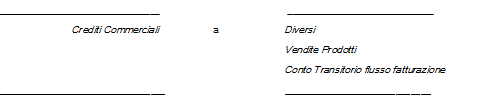
-
the accounts used by the system for booking the indirect tax at the month-end.
-
Transitory write off for accounting. “Transitory” variation account on which the entry for the indirect tax (both debit and credit) is recognised when a debit/credit with the tax authorities arises. This occurs at the end of the month. The double entry that the system generates upon recognition is the following

- VAT Standard balance sheet account that records the Entity’s VAT debit / credit positions towards the State
- VAT debit/credit variation. “VAT” variation account on which at end month the credit/debit variation with the tax authorities is recognised. The double entries generated upon recognition are the usual one described for “Transitory write off for accounting”
-
the accounts used by the system for the payment / reimbursement of indirect tax.
-
Non-deductible account (P&L). P&L account on which the non-deductible amounts calculated by the system are entered.
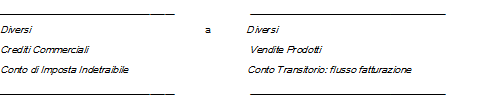
It is possible to opt for management involving the direct booking of non-deductible tax by attributing its value to the original cost/revenue account. To do this, when defining the execution plan on the process (see CFP Execution Plan), the Non-deductible account field must remain disabled. In this case, the double-entry registration is

Where the “Goods Purchase” account is increased by the corresponding amount of indirect tax.
- Indirect tax payment “Indirect tax” variation account on which the variation of the amount payable to the tax authorities is recognised when it is paid. It should be noted that this type of account should not be considered a bank account. The double entries generated when the payment is made are:

-
Bank - credit variation Variation account of the “Bank c/a” account on which the entry related to the payment of the debt to the tax authorities is recognised
-

-
Bank - debit variation Variation account of the “bank c/a” account on which the entry related the collection of the amount receivable from the tax authorities is recognised
-
Ind Tax Collection “Indirect tax account” variation account on which the variation of the amount payable to the tax authorities is recognised when it is collected.
-
by Enable VAT on retail receipts If enabled, a shift is applied in the settlement of the VAT position provided for by the VAT policy. For example, by following the “Standard policy for VAT receipts” the system differentiates the settlement of the VAT position for one month in respect of what is provided for by the legislation; if the payment is scheduled for day 16, the January position will be settled on 16 March (rather than the February position as provided for by the VAT legislation). The reference policy to which to apply the aforementioned shift is specified in the VAT on retail receipts field
-
by rules for payments and reimbursements
-
Frequency, or the periods at the end of which the tax is settled
-
Payment days/months. i.e. the period of time, expressed in days/months, that must pass between the end of the month in which the amount payable towards the tax authorities is calculated and the day on which the payment is made. For example, by entering 15 days and 0 months, and supposing the current date is 31 December, the payment takes place on 15 January; if however the user enters 15 days and 2 months, the payment takes place on 15 February.
-
whether or not the indirect tax must be reimbursable. In cases of reimbursable tax, the tax credit is reimbursed. Otherwise, it is postponed to the next period. In cases of reimbursement, it is also necessary to indicate the reimbursement days/months, or the period of time, expressed in days, months, or days/months, that must pass between the end of the month in which the amount receivable from the tax authorities is calculated and the day on which the reimbursement is made
For example, if the user wants to recognise VAT every month and simultaneously write off the VAT recognised and make the payment, it is necessary to set
- payment days 0
- payment months 0 (all months)
-
and activate the frequency for all periods
-
Holidays if necessary, the user can also specify a calendar of holidays to be used for the payment of taxes if such payment falls on a date defined as a “holiday”
-
Payment days/months. i.e. the period of time, expressed in days/months, that must pass between the end of the month in which the amount payable towards the tax authorities is calculated and the day on which the payment is made. For example, by entering 15 days and 0 months, and supposing the current date is 31 December, the payment takes place on 15 January; if however the user enters 15 days and 2 months, the payment takes place on 15 February.
-
down payment management. The Down payment day option allows the user to tell the system that he wants to manage VAT down payments.
 For the first simulation year, the method for recognition of the down payment is the same as for other entities, which is the statistical account method.
-
the down payment percentage on which basis to calculate the VAT down payment
-
the (payment) day i.e. the day on which the down payment must be made
-
the (payment) period i.e. the month in which the VAT down payment must be made
- the reference period i.e. the period of the previous year that represents the basis for the VAT down payment calculation.
-
the Prev. year statistical tax account or the “other stocks" account used as the basis to calculate the VAT down payment for the first simulation year; for the years after the first, the system automatically calculates the down payments on the basis of the VAT position of the previous year.
-
by a series of information needed if Group VAT must be managed.