The Consolidation scenario
Introduction
A consolidation scenario allows you to define the characteristics of the consolidation area, or the holding company, entities to be consolidated, currency and consolidation method, the original scenario from which to read data, etc. A consolidation scenario is always linked to one - and only one - original scenario, and it contains consolidated data that cannot be edited manually. The same original scenario can be linked to several consolidation scenarios; thus, the same data may be processed differently as long as the different consolidation perimeters and rules are respected.
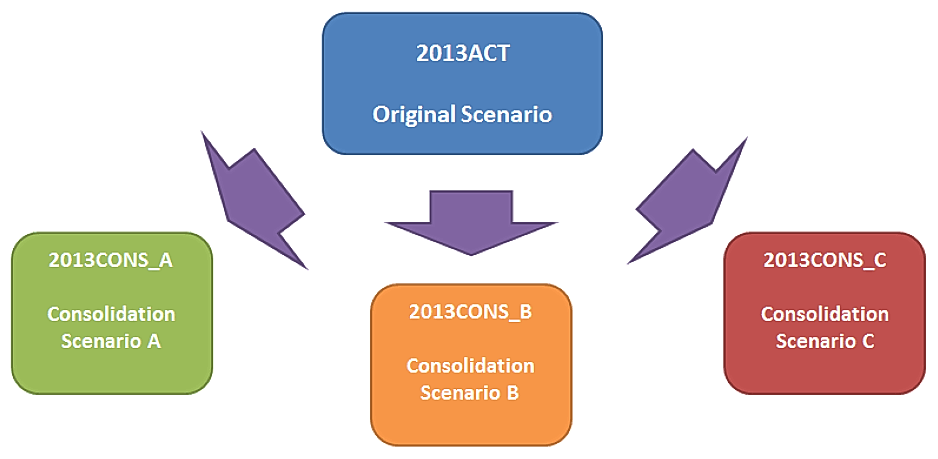
The approach to the consolidation of a group of entities is always FLAT. This means that the data resulting from a sub-consolidation process are never used directly as input data for a higher-level consolidation. The consolidation process always considers the individual entities of the organisational hierarchy.
Example
Based on the original data for the 2020 fiscal year, you can create the following:
- sub-consolidations
- two different consolidation scenarios, one consolidating 10 companies and another consolidating 100 companies
- several consolidation scenarios expressed with a different consolidation currency
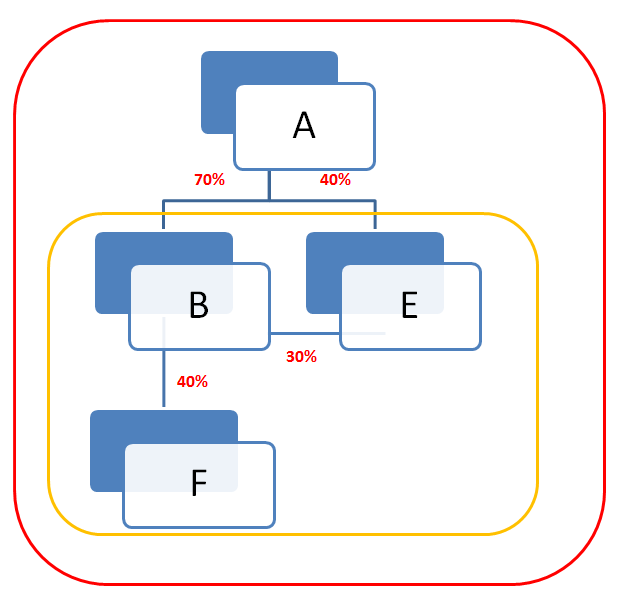
- if company A owns 70% of company B and 40% of company E, and company B owns 30% of company E and 40% of company F, it is possible to create two consolidation scenarios, one - SUB_B - in which company B’s consolidation is obtained, where company E is consolidated at equity, and another - CONS - in which company A’s consolidation is obtained, where company E is consolidated using the line-by-line method.
For more details on the concept of Scenarios, see.
Defining a consolidation scenario
Consolidation scenarios can be defined in two different ways:
| Method | Characteristics | See |
|---|---|---|
| From the scenarios list | All scenarios included in the list are shown. The relationships to the original scenarios/period must be specified. This method allows you to create a consolidation scenario with a certain currency and a certain hierarchy of entities. | |
| In the consolidation area definition, from the requirements of the process for consolidation data processing | - Only the consolidation scenarios/periods related to the original scenarios/periods of the process being set up are displayed. - It is possible to create new consolidation scenarios which are necessarily related to original scenarios/periods of the process being set up. The periods created in the new scenarios are the same as those present on the original scenarios. |
For more details on consolidation scenarios, see .
For a list of the attributes that are necessary to define a consolidation scenario, see .
Defining a consolidation area
A consolidation area can be defined as a requirement of the relative consolidation process. You can carry out this operation from the .
The consolidation area allows you to define:
- which entities must be consolidated
- the consolidation method for each individual entity in the area
- the actual consolidation percentage
- any deconsolidation type
Note: none of the entities excluded from the consolidation area are considered in the data processing for that area.
The consolidation area can be defined for individual entities or for nodes of a hierarchy to which individual entities and/or lower level nodes can be added or removed. It is possible to apply different consolidation criteria for specific entities within a node.
The consolidation area must also be defined for each period present in the consolidation scenario. This is because the number or consolidation method of the entities to be consolidated could change from one period to another.
An entity may have different consolidation methods depending on the consolidation scenario, and to this end, data are present on the original scenario. These data are ignored for the consolidation scenario in which the entity is carried at cost and are only processed on scenarios in which the entity has a different consolidation method.
Consolidation method
For consolidation, the following methods can be applied:
| Consolidation method | Conditions |
|---|---|
| Line-by-line | The entity receives branches of ownership from whole entities, where the sum of their percentages exceeds 50%. |
| Proportional | - The entity receives branches from whole entities, where the sum of their percentages is equal to 50%. or - The entity receives a branch of control from a proportional entity. |
| At equity | - The entity receives branches from whole entities, where the percentage is between 50% and the listed/non-listed entity ownership percentage.defined in configuration. or - The entity receives a branch of control from an entity at equity. |
| At cost | In all other cases |
Assignment of the consolidation method in the area
If, for an entity or node of entities on the consolidation area, the consolidation method is set to from entity table, CCH Tagetik chooses the method present in the table for that entity, or for all the entities of the selected node that are included in the deployment. But this only occurs if the entity: time-dependent management field is set to No. Otherwise, it sets the consolidation method defined on the entity table by scenario/period. The scenario that is considered is the original scenario associated with the processed consolidation scenario.
If, for an entity or node of entities, the consolidation method is set to calculated, CCH Tagetik chooses the consolidation type obtained from the ownership structure register for that entity or for all entities in the deployed node. In particular, for every entity, it considers all branches of ownership originating from entities belonging to the same consolidation scenario. The consolidation method is assigned following the principle of propagation of control. For the definition of the equity consolidation method, CCH Tagetik also considers the Listed attribute defined in the list of entities (or in the entities table by scenario/period) and the listed/non-listed entity ownership percentages defined in configuration.
For the holding company, the line-by-line consolidation method is always chosen.
For the other items in the Consolidation method field, the setup is directly copied from the definition table. If a particular consolidation method is defined for a node, this is overridden on all the entities belonging to the node.
This does not happen for deconsolidated entities, for which the consolidation method is obtained automatically, if possible.