Tagetik Data Loader - architecture
Tagetik Data Loader (hereinafter "TDL") is a programme written in Java installed and run on-premises by the customer and is able to execute tasks driven by CCH Tagetik.
TDL is structured in modules, is 'lightweight' and is dynamic, i.e. it allows modules to be installed, started, stopped and removed at runtime, thus without the need for reboots
These functionalities are provided by the use of an OSGi (Open Services Gateway initiative) framework. TDL is in fact based on Apache Karaf 4.4.0, a small OSGi framework that provides a lightweight container in which to deploy the various components and applications. Karaf 4.4.0 supports the latest OSGi R8 specification.
The TDL architecture consists of three layers as shown below:
- the first layer is the framework
- the second is the service layer
- finally, the third is the application layer
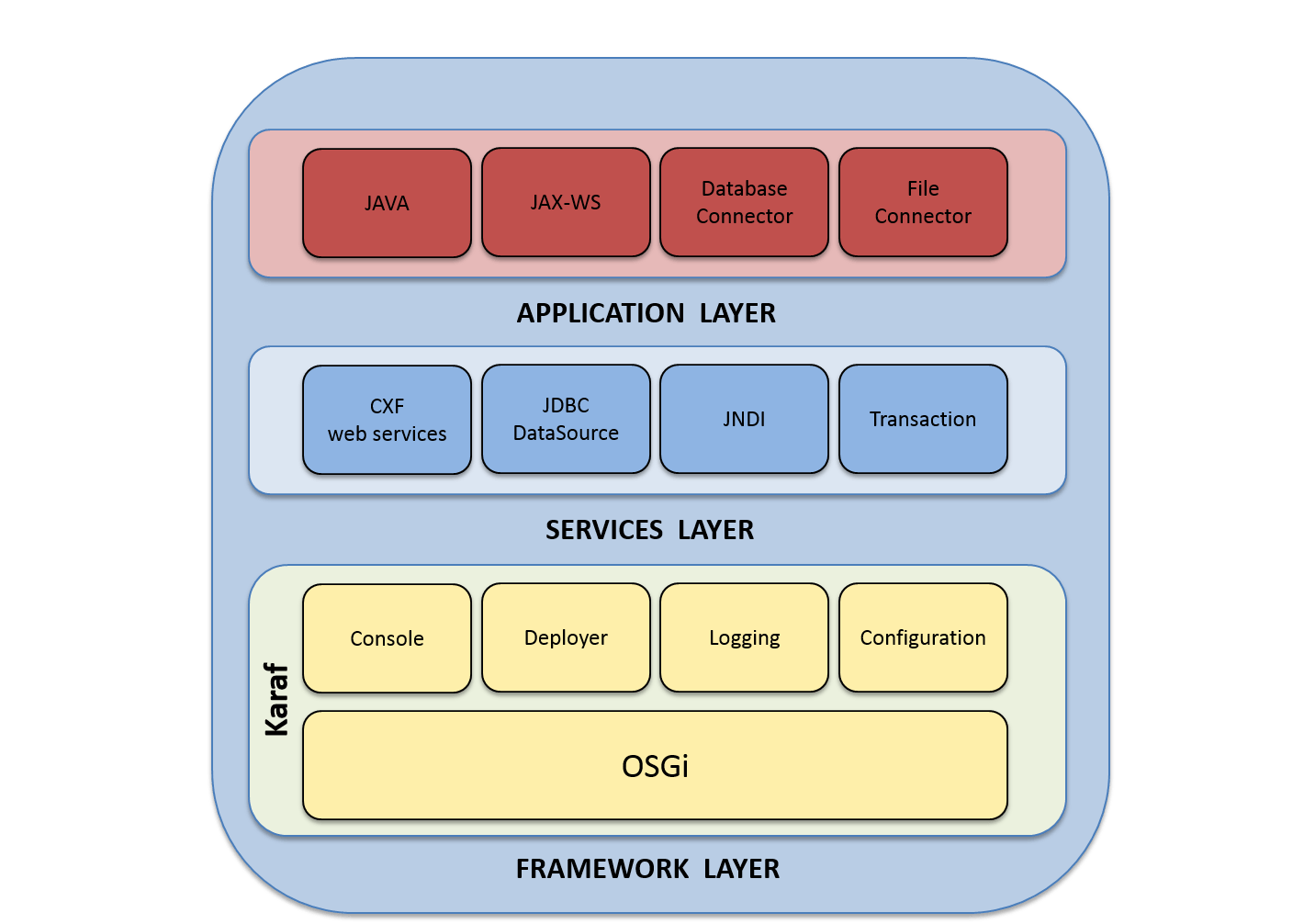
Framework layer
Apache Karaf is a small OSGi framework, which provides a 'lightweight' container in which the various components and applications can be deployed. The framework supports the following functionalities:
- 'hot update'. Karaf supports hot deployment of OSGi bundles by tracking jar files within the [home] / deploy directory. Whenever a jar file is copied into this folder, it is installed without requiring a restart of the container
- dynamic configuration. The configuration of services is done using properties files within a dedicated directory. These configurations are monitored and changes to properties files are propagated to the services
- log system. Karaf supports a large range of logging frameworks (slf4j, log4j, etc.) that can be configured via a single file
- administration console. It provides an Unix-like console through which the container can be fully managed. It is also possible to extend the console and create your own customised commands.
Services layer
The service layer, located above the framework layer, interacts with the application layer to communicate with customer-developed applications that need to access and use these services. The available services are:
- JDBC DataSource Factory. Provides services to access databases from OSGi applications running in Karaf and to extract data from the database by installing DataSources as OSGi services
- JNDI. Karaf Naming (JNDI) is a feature that provides a centralised register/query function for OSGi services. JNDI API is typically used to access services from a system directory
Application layer
The Application layer is where the applications developed by Tagetik reside. It consists of java programmes that implement connectors, execute tasks and communicate with Tagetik via web services.