Routines
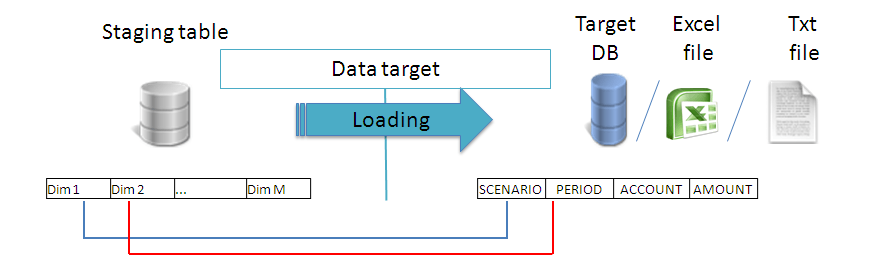
A routine is the minimum data processing unit that can be run in an ETL process and contains all the information for extracting, transforming and loading the data. It is made up of:
- one or several extraction tasks which allow you to extract data from one or several types of source;
- one or several transformation tasks that allow you to manipulate and convert extracted data;
- one or several loading tasks that allow you to load previously extracted and/or transformed data onto one or several target types.

IMPORTANT: as a best practice, when the data to be extracted and processed are “uniform” (e.g. they are either all amounts of various nature or all structural elements) it is recommended to create a single routine.
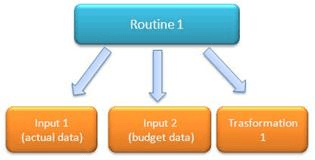
Thus, the data will all be extracted together and transformed according to the same logics (Transformation 1).
If, however, the data are “non-uniform” (e.g. amounts and structural data), it is recommended to define a routine for each type of data to be extracted.
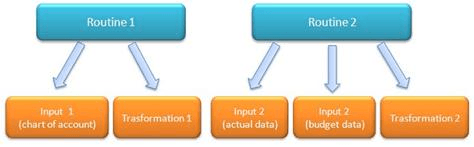
In this case, the data extracted by Routine 1 will be processed by Transformation 1, whereas the data extracted by Routine 2 (Input 2 and Input 3) will be processed by Transformation 2 in the example.
In CCH Tagetik, the standard routines belonging to the standard ETL domainsexist by default. Using these,you can load both “structural” data (elements of dimensions, hierarchies and groupings) and “values” (amounts, intercompany values, adjustments and FX rates). These routines cannot be edited or deleted by the user.
New custom routines, which are fully configurable, can be created (including as copies of standard routines), in order to meet specific business needs.